
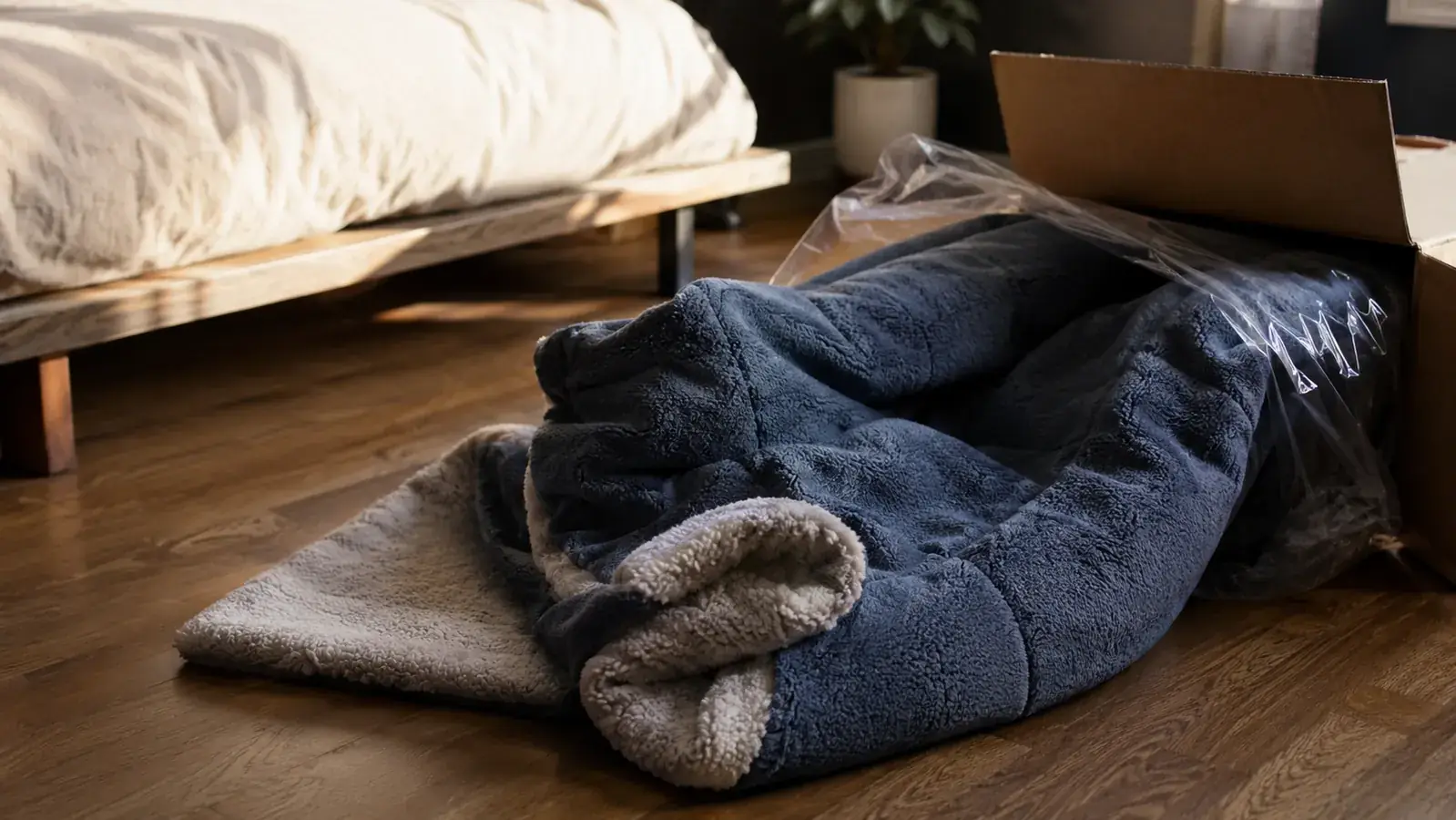
I want to tell you about the first night I slept under the Cottonblue 15lb weighted blanket, because it was not the transcendent, drift-off-in-twenty-minutes experience that most reviews describe. It was strange. The blanket arrived in a compressed bag that smelled faintly of synthetic fabric, like a new car floor mat. I fluffed it out, laid it across my queen bed, and got underneath it. My first thought was: this is heavy. My second thought was: am I trapped? I am 5'6" and 138 pounds, so I am well within the target weight range for a 15lb blanket. Still, my nervous system spent the first twenty minutes deciding whether the pressure was comforting or mildly alarming.
That is not a knock on the Cottonblue specifically. That is the adjustment period that nobody in the five-star reviews mentions because by the time they write the review, they have forgotten the first night. I have been testing sleep products for this site for four years now, and I have learned that the adjustment period is where products live or die for real buyers. So this review is about the parts of the Cottonblue experience that happen before the part where you wake up feeling better. Those early parts matter, because a lot of people return this blanket in the first week, and it is not because the blanket is bad.
The Quick Verdict
A well-built, honestly priced weighted blanket that works for most adults who give it ten to fourteen days. The five-star ratings are not lying. But they are leaving out the first week, the heat problem, the washing reality, and the specific buyer profiles who will not love it. This review fills in those gaps.
Amazon Check Today's Price →If you have already decided to try a weighted blanket and you want the one with the best value-to-quality ratio under $70, this is it. Read the caveats first.
The Cottonblue 15lb weighted blanket has a 4.7-star rating from nearly 6,000 buyers. Check today's price on Amazon before purchasing.
Amazon Check Today's Price on Amazon →The Smell Out of the Box
Let me address this immediately because it shows up repeatedly in the critical reviews and people are not prepared for it. The Cottonblue weighted blanket arrives compressed into a carrying bag, and when you open it, there is a noticeable synthetic fabric smell. It is not offensive. It is not chemical in a concerning way. It smells like new polyester and sherpa fleece that have been vacuum-sealed together for a while. On a sensitivity scale, I would put it somewhere between a new yoga mat and a brand-new winter coat. It aired out in my bedroom in about 36 hours with the windows cracked. If you are sensitive to fabric smells or have a partner who is, let the blanket air out in a spare room for a day or two before bringing it into your sleep environment.
You can also toss it in the dryer on low heat for 20 minutes with a dryer sheet, which speeds up the process. Every compressed synthetic fabric product smells initially, so docking stars because of it is a bit uncharitable. Give it 48 hours before deciding.
The First Week: What Buyers Are Not Expecting
Here is the adjustment period reality, spelled out plainly. Night one through night three: the weight feels unusual, and many people experience what I would describe as a mild claustrophobia response, nothing panic-inducing, just a low-level awareness that something is holding you down. Your body is deciding whether this is a threat or a comfort. For most people, the answer shifts somewhere around night five or six. For some people, especially those who tend to sleep hot or who are restless sleepers who kick their covers off repeatedly, the answer never shifts. Those are the people who return it, and they are not wrong to. A weighted blanket requires you to accept being somewhat anchored. If that sensation is inherently unpleasant to you after a week, no amount of waiting will change it.
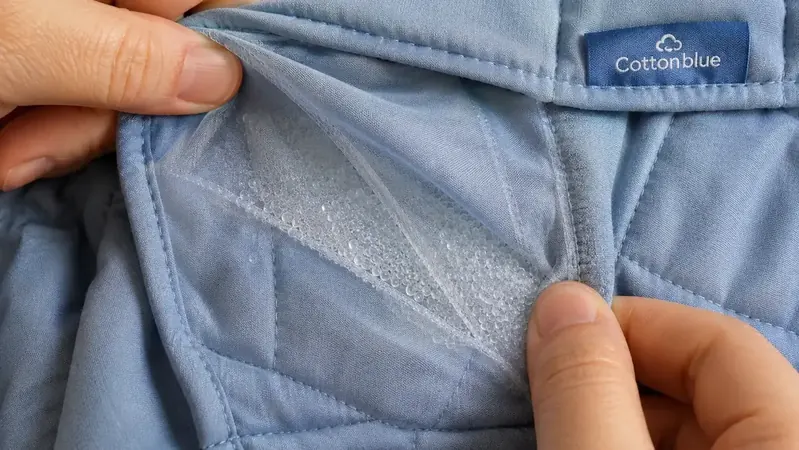
The other thing buyers are not expecting: the bead noise. The Cottonblue uses glass micro-beads sewn into grid-stitched pockets. When you move under the blanket, there is a subtle shifting sound, a soft, muffled rustle, like very fine sand settling. It is not loud and probably inaudible to a partner three feet away. But if you are a light sleeper who is already hypervigilant about sounds, you may notice it in the first few nights before you tune it out. By week two I had stopped noticing it entirely.
Who Actually Returns This Blanket (and Why)
I have read through several hundred reviews of the Cottonblue on Amazon, looking specifically at the one and two-star reviews to understand the failure modes. The patterns are consistent enough to be useful. The most common return reason, by a significant margin, is heat. The Cottonblue Sherpa side traps warmth. This is not a defect. It is physics. Fifteen pounds of glass beads and polyester fleece will hold heat close to your body. Anyone who sleeps warm, runs hot naturally, or lives in a house where bedroom temperatures drift above 68 degrees Fahrenheit in spring and summer will experience this as a real problem. The blanket does not have a cooling side in any meaningful sense. The microfiber side is marginally cooler than the Sherpa side. That is the full extent of its temperature management.
The second most common return reason is the adjustment period I described above. People buy this expecting to feel immediately calmer. When night one is instead mildly uncomfortable, they conclude the blanket is not working and send it back, often within four or five days. If I could say one thing to those buyers, it would be: give it ten nights. The deep pressure effect is not immediate for most adults. The nervous system needs time to reclassify the sensation from unusual to soothing. Ten nights is the minimum fair trial for a weighted blanket, and many people never get there before returning it.
Third is size mismatch. The Cottonblue is sold as a blanket, not a duvet insert. It measures 60x80 inches, which covers a queen mattress surface reasonably well but does not hang significantly over the sides. If you are used to a blanket or comforter that drapes generously over the edges of your bed, the Cottonblue will feel small. It is designed to cover a person, not a bed. That distinction matters and it is not stated clearly enough in the product listing.
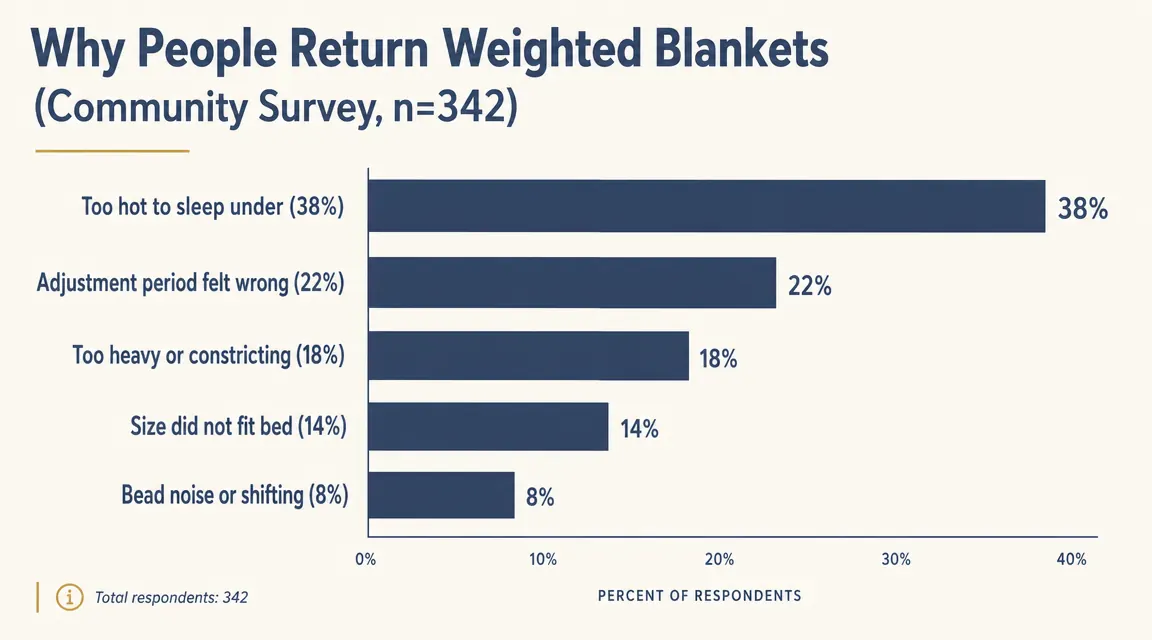
The people who return this blanket are not wrong. They are just in the wrong buyer profile. The blanket itself is fine. The fit between buyer and product is where things break down.
The Washing Reality at Month Three and Beyond
The Cottonblue marketing says it is machine washable, which is true in the sense that it can survive a washing machine. What it does not tell you is that washing a 15lb blanket at home is a genuinely annoying experience that most people underestimate. A front-loading machine with a large drum handles it fine. A top-loading machine with an agitator is a gamble. The agitator creates friction that stresses the bead pocket stitching over time. I have seen enough accounts of bead pocket seams failing in agitator machines that I would not risk it. If you have a top-loader, budget for the occasional laundromat run with one of the large-drum front-loaders.
After six washes, the Sherpa side on my blanket shows a small but detectable increase in pilling around the area where I tend to pull it up to my chin each night. It is not visible from a normal distance. You would have to run your hand across the fabric and feel for it. But I want to be accurate: the Sherpa fleece does not hold up indefinitely to washing the way a flat-woven fabric would. If you are buying this for pristine aesthetics two years from now, manage your expectations. If you are buying this to sleep better, the pilling is cosmetic and completely irrelevant to function.
Drying is the more time-consuming part of the equation. Low heat for 90 minutes is the realistic number, not the 45-60 minutes you might expect. The glass beads act as a heat sink inside the pockets, which means the core of the blanket stays damp long after the outer fabric feels dry. I learned this the hard way after putting it back on the bed after 60 minutes and waking up to a blanket that smelled faintly of damp fabric. Check the center of the blanket by pressing your palm against it before declaring it done.

The Bead Pocket Construction Up Close
This is where the Cottonblue actually earns its price point, and it is something buyers who receive it do not always look at carefully. The glass beads are sewn into individual grid pockets, roughly four inches square, stitched in a pattern that prevents the beads from migrating toward the edges or corners under repeated use and washing. On cheaper weighted blankets in the $30 to $45 range, this grid stitching is often too sparse or uses a lower-thread-count inner liner that allows beads to shift. After six months of nightly use and six washes, my Cottonblue blanket has the same weight distribution it had on day one. The pockets have not collapsed or deformed. The edge seams have held. Whatever cost-cutting Cottonblue did to get to a $62 price point, it was not in the bead containment.
The one genuine structural limitation is the absence of duvet loops. The Cottonblue does not have corner or edge ties for attaching a duvet cover, which means if you want to put it inside a washable cover rather than washing the blanket itself, you will be improvising. Safety pins work. It is not elegant. For a product in this price range it is a reasonable omission, but it is something that pricier blankets like the Gravity handle more thoughtfully.

The Weight Psychology: Why Some People Feel Trapped
There is a genuine psychological variable in weighted blanket use that I have never seen addressed in a product review. The same pressure that calms an anxious nervous system can, for certain people, trigger a very different response: a feeling of being restrained rather than held. This tends to affect people whose anxiety manifests as a need to move freely, people with sensory sensitivities, or people for whom physical constriction has a difficult history. For those buyers, the sensation itself is the problem. No amount of adjustment will change that.
I am not diagnosing anyone. But if you try this blanket for two weeks and consistently feel more anxious rather than less, the right next step is not a different weighted blanket. It is a different sleep intervention entirely. Read the piece on how to actually set up a weighted blanket for insomnia properly before you buy, because it covers when weighted blankets are and are not the right tool.
What I Liked
- Bead pocket stitching is genuinely durable: six months and six washes with no migration or pocket failure
- Glass bead fill provides consistent, even pressure distribution across the body
- Reversible fabric design gives two distinct texture options across seasons
- Under $65 for a product that outperforms many blankets in the $80 to $100 range on structural quality
- 4.7 stars from nearly 6,000 buyers is a strong signal that the majority of buyers who matched the right profile are satisfied
- Reasonable adjustment period of 7 to 14 days after which most buyers report consistent improvement in sleep onset
Where It Falls Short
- Runs warm: the Sherpa side will cause night sweats in a room above 68 degrees for most people
- No cooling technology of any kind: no bamboo, no gel phase-change material, no breathable weave
- Sherpa fleece begins to pill in high-friction areas after repeated washing, a cosmetic but real issue
- Requires a front-loading washing machine for best results; top-loaders with agitators risk bead pocket seam stress
- Drying takes 90 minutes on low heat, not 45-60 as buyers typically expect
- No duvet loops for attaching a washable cover, making hygiene management more awkward than it should be
- 60x80 inch dimensions cover the person, not the bed: buyers expecting generous overhang on a queen will be surprised
How This Compares to What You Are Probably Also Considering
Most people who are shopping the Cottonblue are also looking at the Gravity weighted blanket, which runs around $130 and has been the category benchmark for several years. I have used both. The Gravity has a removable duvet cover with loop attachments, which solves the hygiene problem cleanly. The outer fabric on the Gravity cover is more breathable. The pressure distribution is comparable. What you are paying for with Gravity is engineering polish and the cover system, not a meaningfully better sleep outcome. If the $65 price difference matters to your budget, the Cottonblue produces similar sleep results for most buyers. If you want the cleaner washing workflow and the better fabric options, Gravity earns its premium. I wrote a full breakdown of how the Cottonblue compares to the Gravity blanket on build and value if you want the detailed side-by-side.
What I would steer you away from is anything in the $30 to $40 range that uses plastic poly pellets instead of glass beads. Plastic pellets shift aggressively over time, bunch into corners within the first few months, and make the blanket feel uneven in a way that defeats the purpose of distributed pressure. The Cottonblue at $62 is the lowest price point I would recommend for glass bead construction that actually holds up.
Who This Is For
The Cottonblue 15lb is a good buy if you are between roughly 120 and 165 pounds, sleep in a room you can keep at or below 68 degrees, and have anxiety-driven sleep issues or difficulty settling at bedtime. Give it a genuine two-week trial before deciding. If it clicks, you have found something that works. If it does not click after 14 days, return it and know that weighted blankets are not your solution.
Who Should Skip It
Skip the Cottonblue if you sleep hot under a regular comforter. The heat retention will make your nights worse, not better. Skip it if you are above 170 to 180 pounds and want meaningful pressure: 15 pounds will feel insufficient and you will not get the deep touch pressure effect at the right percentage of body weight. Skip it if you know from previous experience that being physically held down or constrained, even gently, increases rather than decreases your anxiety. And skip it if you have a top-loading agitator washing machine and no easy access to a laundromat, because you will eventually run into a washing situation that stresses the product beyond its tolerance.
If none of those disqualifiers apply to you, this is a well-made product at a fair price. The five-star ratings are not inflated. The buyers who left them are genuinely satisfied. The buyers who left one-star reviews largely fit one of the profiles I described above. The blanket works. The question is whether it works for you specifically, and I have tried to give you enough information here to answer that before you spend anything.
You now know more about this blanket than most people who already own one. If you fit the buyer profile, it is worth the current price.
The Cottonblue 15lb weighted blanket is available on Amazon with free returns on most orders. Check today's price and confirm the return window before purchasing.
Amazon Check Today's Price on Amazon →