
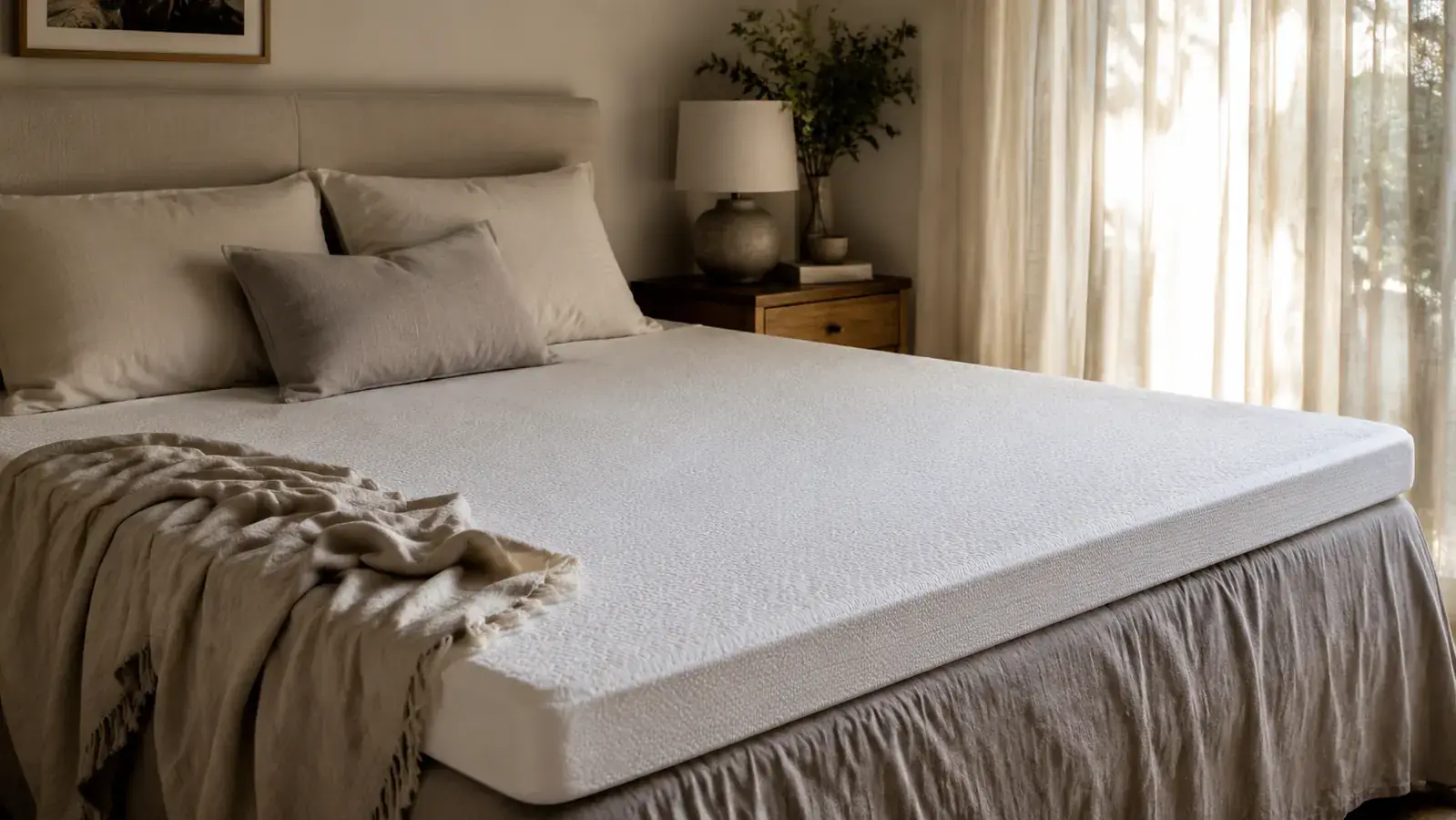
My mattress was seven years old, too firm by at least two comfort levels, and waking me up with a dull ache across my left shoulder every single morning. I knew I needed to do something. What I did not want to do was spend $1,200 on a new mattress while also juggling a renovation in the guest room and a teenager who had just started driving. So in February I bought the Lucid 3-inch gel memory foam topper, which had north of 100,000 Amazon reviews and cost me right around what I expected. And then I slept on it for four months before writing a single word about it.
I want to be clear about the starting conditions: my base mattress is a mid-range innerspring from 2019. Not coils-so-old-they-poke-through, just firmer than my body wanted. The topper was always going to be doing work on top of a functioning foundation. If your base mattress is genuinely shot, a topper is not a rescue, and I will come back to that point. But if your mattress is structurally sound and just the wrong feel? Keep reading.
The Quick Verdict
A legitimate quality-of-sleep upgrade for firm sleepers who are not ready to replace a working mattress. The off-gassing window and the first-week break-in period are real, but after week three this topper delivered noticeably softer pressure relief on my shoulder and stopped my 3am wake-ups almost entirely.
Amazon Check Today's Price →Your mattress is fine. Your sleep is not. Here is the fix that costs less than a weekend away.
The Lucid 3-inch gel topper has 103,000+ reviews and ships to your door. If you are waking up sore from a firm mattress, this is the most direct path to relief without a full mattress swap.
Amazon Check Today's Price on Amazon →How I've Used It: The Setup and the First Week
The topper arrived rolled and compressed in a box about the size of a large duffel bag. I wrestled it onto the bed, cut the plastic wrap, and let it expand for 48 hours before sleeping on it. That is the part no review told me clearly enough: the off-gassing from new memory foam is real, and it is not subtle. I cracked two windows and kept the bedroom door open for two days. By night three the smell was down to a faint background note. By night seven it was gone. If you are chemically sensitive, plan on a four-to-five day off-gas window before the first night's sleep.
I put a deep-pocket fitted sheet directly over the topper and the mattress together. The 3-inch foam adds enough height that my standard sheets were suddenly short. I had to order one set of deep-pocket sheets (18-inch depth) before the whole setup felt properly made. Budget for that if you have standard-depth sheets. The topper itself does not come with any fastening straps, and I was worried it would shift. After four months it has moved maybe two inches toward the foot of the bed. Not enough to matter, but worth noting for anyone who moves around a lot during sleep.
The first three nights felt too soft in an unfamiliar way. My body had adapted to the firm mattress and the extra give felt strange, not immediately better. By night ten I stopped noticing the adjustment and started noticing the absence of morning shoulder pain. That is when I started tracking it.
Pressure Relief Over Time: What the Data Showed Me
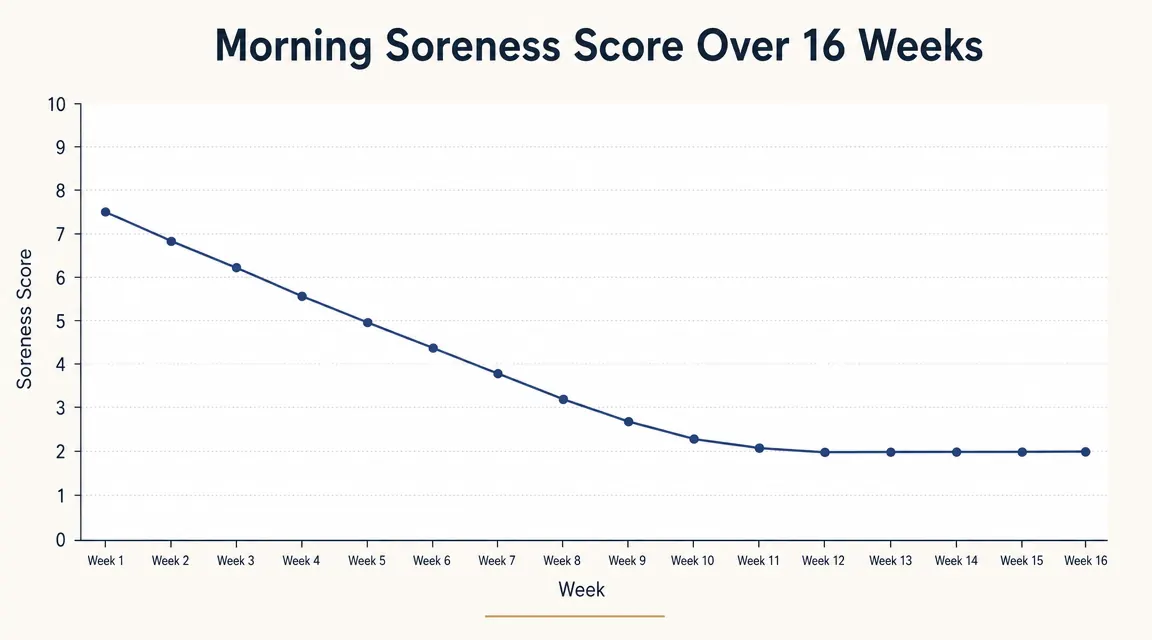
I am not a sleep-lab person, but I kept a simple morning soreness log. On a scale of one to ten, how bad was the shoulder ache when I got out of bed? Before the topper I was consistently a six or seven. Occasionally an eight on days I had been tense. At week four I was averaging a three. By week eight I was under two and some mornings I did not notice anything at all. That is not a small change for something that cost less than a single chiropractor visit.
The gel infusion is supposed to help with heat. I sleep warm, and heat retention in memory foam was my biggest concern going in. The honest result is: this topper runs a little warmer than my uncovered mattress, but nowhere near as hot as I feared based on reviews of standard (non-gel) memory foam. I typically sleep with a ceiling fan and light cotton sheets, and in that setup I did not wake up sweating through March and April. June will be the real test. I cannot speak to summer performance yet, but for the shoulder-relief question it delivered.
Ingredient and Construction Deep-Dive: What You Are Actually Buying
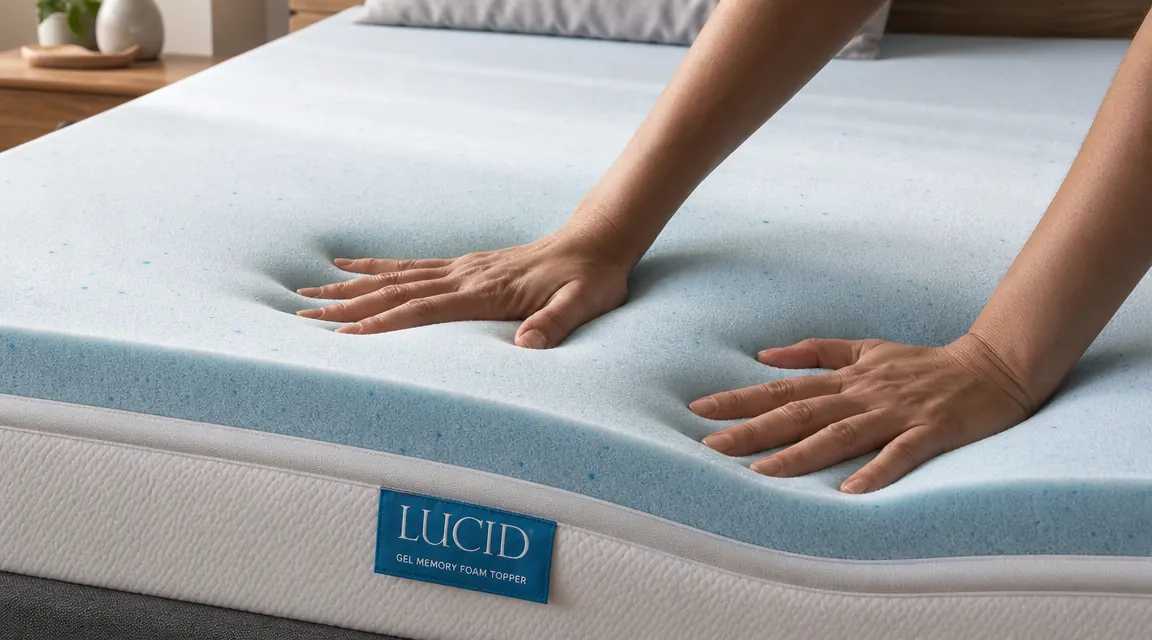
The Lucid 3-inch topper is CertiPUR-US certified memory foam with a gel bead infusion throughout the material. CertiPUR-US certification means the foam has been tested for harmful chemicals including formaldehyde, heavy metals, and ozone depleters. It does not mean zero off-gassing, but it does mean the off-gassing that occurs is within acceptable safety limits. That was important to me when I was sleeping in the same room two days after opening it.
The density on this foam is not published by Lucid, which is a mild frustration. Higher-density memory foam (4 lb or above) holds up better over time and provides more durable pressure relief. Lower-density foam (under 3 lb) compresses faster. Based on how the topper feels after four months, my guess is it sits in the 3-to-3.5 lb range, which is middle-of-the-road for this price point. It has softened slightly since month one but has not developed any noticeable body impressions. I will revisit this assessment at the one-year mark.
The topper is not reversible and has no cover or zipper included. If you want a cover to protect the foam and add a washable layer, you buy that separately. I added a basic quilted cotton topper cover for around $30, which I can pull off and wash. The foam itself is spot-clean only, so a washable layer is not optional in my house.
Sleeping Position Performance: Side, Back, and the Occasional Stomach Night
I sleep mostly on my left side, which is why the shoulder issue was so pronounced. The 3-inch depth is genuinely enough to take my shoulder out of direct contact with the firm innerspring beneath. The foam lets the shoulder sink just enough, keeps the hip at the right height, and the resulting spinal alignment feels right when I wake up. For side sleeping specifically, this is where the topper earns its rating.
When I roll to my back, the topper is softer than I personally prefer for back sleeping. Back sleeping on memory foam can make you feel like you are sinking slightly into a hammock. It is not painful, it is just not the firmness I would choose for back-only sleeping. If you are a back sleeper with a too-firm mattress, I would consider a 2-inch topper instead of 3 inches. The 3-inch depth is optimized for side sleepers.
Stomach sleeping on this topper is a non-starter for me personally, though that is true of almost all memory foam, which tends to tilt the pelvis in ways stomach sleepers find uncomfortable. That is a foam physics issue, not a Lucid issue.
By week eight I was rating my morning shoulder pain below a 2 out of 10. Before the topper it was consistently a 6 or 7. That shift happened in under two months for less than a hundred dollars.

Alternatives I Considered Before Buying
I seriously looked at the ViscoSoft 3-inch topper before landing on Lucid. The ViscoSoft has a higher published density claim and includes a removable cover, which is a legitimate advantage. It also costs roughly $40 to $60 more depending on the sale cycle. I went with Lucid because the review volume gave me more confidence in long-term durability data, and because I planned to buy a cover separately anyway. If you want a topper that ships ready-to-use with a washable layer included, the ViscoSoft is worth the extra spend. For a deeper comparison of those two, I wrote a full side-by-side in my Lucid vs ViscoSoft mattress topper comparison.
I also looked at latex toppers, which run cooler and bounce back faster than memory foam. The problem is that a quality latex topper in the 3-inch range runs $200 to $350, which starts to close the gap with a new mattress. For what I was willing to spend on a test before committing to a full mattress replacement, memory foam at this price point made the most sense. And, to be honest, the pressure-relief performance justified the trade-off.
Tradeoffs Worth Naming Plainly
The topper is not thin enough to sit on an adjustable base without limiting the range of motion. If you have an adjustable frame that you like to raise at the head or foot, a 3-inch foam topper will resist that movement and possibly shift out of position. Adjustable-base households should go with a 1-inch or 2-inch topper maximum.
Edge support is reduced. Memory foam toppers, including this one, compress at the edges when you sit on the side of the bed. If you have mobility issues and need a firm edge to push off from when getting up, a foam topper removes that advantage from your mattress. This is a genuine functional drawback and not something most reviews mention.
And again: if your base mattress is sagging or has visible body impressions, a topper will not fix that. You will feel the sag through the foam within a few weeks. The topper assumes a structurally sound base.
What I Liked
- Pressure relief for side sleepers is real and noticeable within two to three weeks
- CertiPUR-US certified foam is a meaningful safety standard, not just a marketing label
- 103,000+ reviews give you a substantial durability data pool before you buy
- At this price point, it costs less than one or two months of a new mattress payment plan
- Gel infusion keeps it cooler than standard memory foam, manageable in a fan-cooled room
Where It Falls Short
- Off-gassing is significant in the first 48 to 72 hours, plan accordingly
- No cover or straps included, add $25 to $35 to your budget for those separately
- Density is not published, making long-term durability harder to predict against competitors
- 3-inch depth may be too soft for back sleepers who want gentle firmness
- Reduces edge support, which matters for people who sit on the bed edge to get up
Who This Is For
This topper is the right buy if you sleep primarily on your side, your mattress is structurally sound but just too firm, and you are not ready or not able to spend $1,000-plus on a full replacement. It is also a smart stop-gap if you are planning a mattress upgrade in the next year but need immediate shoulder or hip relief in the meantime. If those describe your situation, the Lucid 3-inch topper will almost certainly help. To understand the broader case for why memory foam toppers work so well for most sleep complaints, the 10 reasons a memory foam topper improves sleep article breaks it down in detail.
Who Should Skip It
Skip this topper if you sleep hot and do not have a ceiling fan or climate control in your bedroom. Memory foam retains heat, and the gel infusion only goes so far without airflow. Also skip it if you are a primary back sleeper who wants to preserve some firmness, if you use an adjustable base with frequent position changes, or if you have noticed visible sagging in your current mattress. In that last case, put the $100 toward a new mattress fund rather than applying a layer of foam over a failing foundation.
Four months in, I would buy this topper again. Here is why the math still works.
The Lucid 3-inch gel topper is the most practical path between a firm mattress that is hurting your sleep and a full replacement you are not ready for. Current price and availability on Amazon below.
Amazon Check Today's Price on Amazon →